Film Reviews 4U the Bullitt Film 1968

The Film, the Cars and the Enigma that is Steve McQueen -
a cocktail that was blended to great success
Have you ever watched the 1968 film Bullitt starring Steve McQueen and wondered what it is all about? You are not alone.

The movie poster from the film
Once you get past the lead actors and that famous car chase you are left with the enigma of who is Johnny Ross and what is Walter Chalmers really about and why?

the scene shot on location in the Hospital
With a great score by Lalo Schiffrin (who wrote the Mission Impossible theme and other famous television theme music ) and based on a story named Mute Witness by Robert Lloyd Fish (who also wrote as Robert L Pike, the L stood for Lloyd).
The Mute Witness story was adapted into the production screenplay we know today as Bullitt. Steve Mc Queen and his then wife the actress Neile Adams jointly worked on the movie script they were given, making adjustments as they envisaged it to transfer to live action film. It took some urging for McQueen to take the role and the rest is history.

Steve McQueen and then wife Neile Adams -
both worked on revising the screenplay
Steve McQueen avoided lengthy dialogue on his part in the film. He only needed visual hints and expression through his visual acting ability and the clever cinematography to say what he doesn't need to. A look, a gesture and that saves words and conveys more in the action.
.jpg)
Facsimile credentials for Lt. Frank Bullitt
Originally the film was also offered to Clint Eastwood who would later go onto the Dirty Harry film canon, with some of those films also made in San Francisco, McQueen did prevaricate on the offer of the role of Frank Bullitt until his wife persuaded him to take it.

Steve McQueen exuded pure style in the film -
no doubt also making the already popular Mustang an even greater top seller
McQueen was perfect for the role of Frank Buliitt, although seeing the later Dirty Harry films, Clint Eastwood could have equally handled the role, as Eastwood was also of the minimal dialogue school. The location use of San Francisco was used primarily because the city wanted to attract tourism and the film was cheaper to shoot in San Francisco than Los Angeles.
The original car chase was agreed to not exceed 35mph on the suburban streets, however, speeds of 90mph were reportedly achieved! It took some length of filming to get the ten minute chase sequence in the can. There are continuity differences in the finished chase sequence as a result of editing of the amount of film shot.

with Lt. Frank Bullitt (Steve McQueen)
The story opens with Lt. Frank Bullitt (Steve McQueen) called in by Captain Bennett to babysit a States Witness Johnny Ross on behalf of State Senator Walter Chalmers (Robert Vaughn) and for the Police to deliver Ross to the Court Hearing on the Monday morning. (Both McQueen and Vaughn had previously starred together in the 1960 film the Magnificent Seven).
Unfortunately for Chalmers, the Chicago Mob has other ideas about Ross squawking and spilling the Beans about their business, they don't want Ross who knows the modus operandi of the outfit to appear or to talk at the hearing.

Paul Genge and Bill Hickman
A hitman (Paul Genge - who appeared in the Invaders TV series) is sent to take care of Ross, now ensconced in a seedy flophouse backstreet Hotel, the hitman shoots Ross and the undercover Detective guarding Ross.

Ross or not Ross?
Renick stands in for Ross
Both casualties are rushed to Hospital, Ross is dead and then stored under a John Doe ID to avoid Chalmers or the Mob knowing Ross is dead, Bullitt then keeps the story Ross is alive going, hoping to draw out the hit men and other players in the game.
Chalmers visits the Hospital and is told that Ross has been moved, Chalmers demands to know where, but Bullitt reasons that the Hotel location was supposed to be restricted knowledge, but the hitman found it and the less people that know now where Ross is, the better.
Chalmers later accuses Bullitt of using Ross for 'self aggrandisement' however it is a case of the pot calling the kettle black on the part of Chalmers! Chalmers is obviously looking to leverage Ross for his own ends in an act of the same nature.

The hipster Lawyer informer Eddy (Justin Tarr)
Eddy supplies info on Ross and has a friend in
St Quentin he asks Bullitt to put a word in for
This sets off a bitter play and counterplay between Chalmers and Bullitt over Ross. Bullitt is followed to the hospital by the hitman who attacked the Hotel room who is is being driven (by Bill Hickman) in a Dodge Charger, a gun battle ensues and the hitman escapes.
Later after collecting his car, Bullitt realises he is being followed to lead the hit men to where Ross is now safely located and starts a drive around San Francisco (the city where the later Dirty Harry film was set).
(The car chase sequence that followed was inspired by the sequence in the1967 film 'Robbery' starring Stanley Baker, which features a car chase choreographed by Director Peter Yates across the back streets of London. Stanley Baker is always a great performer and this film is worth a look too.)

The 1967 film Robbery's car chase -
got Peter Yates the Director's seat in Bullitt -
a long way from the sedate 'Summer Holiday' film Yates directed in 1963

The Peter Yates directed Summer Holiday musical -
a 30mph London Bus trip across Europe!
McQueen on seeing the film 'Robbery', wanted Yates to direct Bullitt, likely wanting to incorporate a car chase of similar high octane which McQueen would drive in, handling the duty with stunt driver Bud Ekins amongst others - Bill Hickman the driver of the Dodge Charger in the chase sequence already being a stunt driver, would later also appear as an actor in the French Connection and the Seven Ups films.

Steve McQueen later wanted to buy the Mustang car from
the film years later, but the then owner wouldn't sell
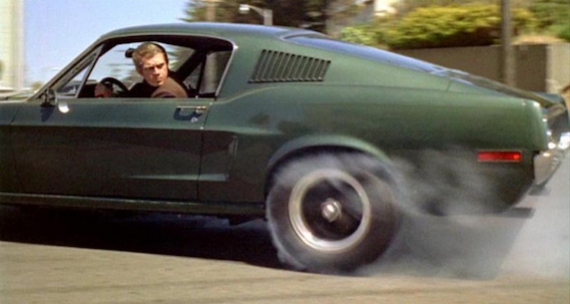
The ten minute Bullitt car chase is now legendary and likely led to the many pursuit scenes that followed in American films since. McQueen drives a 1968 Ford Mustang GT390 (the production line Mustang used the smaller version 289 CUI V8 engine in their main production cars with the 390 being a special high performance engine option).
The cars used in the chase sequence were uprated for the film to provide better handling and performance.

The iconic GT 390 Mustang in the chase sequence -
prices for this fastback variant are significantly higher
than for the stock coupe version - thanks to the film
The distinctive Highland Green used on the Mustang was not a popular colour in the Mustang range until the film came out and a special batch of the cars was produced in that shade due to demand afterwards. The car lost the front grille badge on the film to purposely make it look more 'undercover'. Two Mustangs were used in the film and both survive. One sold for $3.7 Million USD!
(The other chase car was a 1976 Dodge Charger in Black, one of two used in the film.)

Out of town the chase continues
Back to the film and a shakedown of Ross's suitcase leads to the knowledge that the Ross in the morgue is actually one Albert Renick, a Chicago Car Salesman, who bears a good resemblance to Ross. Chalmers has not apparently rumbled that Ross is Renick or knows but that is part of a possible ruse.
Perhaps Chalmers is hoping that the real Ross will fly in and testify once the hitmen are diverted to finding the stand in and making the successful hit. Renick's wife is staying separately in a motel in San Matteo, California and is later killed in the film by other hit men.
It transpires that the real Johnny Ross is now in San Francisco and Ross has booked a direct flight to London. This knowledge of Ross's inclusion on the London flight from the passenger list at the airport leads to a chase around the San Francisco airport where Ross shoots a Deputy Sheriff and where Ross is then shot and killed by Bullitt.

The real Ross (Pat Renella) - at the airport
In a nutshell that is about the film on the face of it. But the interest of Walter Chalmers is the clincher, when did he know Ross was not Ross? Or did he not? Did he set up Renwick to get the Chicago outfit off of Ross's back or perhaps his own? Did Ross set up Renwick to impersonate him? Or did Chalmers believe that the Ross in the Hotel was indeed Ross?
Did Chalmers have an interest in seeing Ross not testify or to be got at nearer the time of the hearing, perhaps on the steps of the building? Either way Chalmers could then come out of it smelling of Roses and shifting the blame, to enhance his own political career.

Chalmers demands Ross is handed over
Perhaps seeing the original book may provide some answers, or not, seeing as the film's screenplay is modified from the original book.
This is why the film has at least two levels, the apparent and the deep. The obviously apparent hides the depth.

Jacqueline Bisset as Bullitt's girlfriend Cathy -
she is portrayed as a modern career woman -
as an Architect - showing that anything is possible
and breaking through the conventions of the time
Bullitt is one of my favourite films, I know how it ends but that doesn't stop me from watching it again and again. The San Francisco scenes are great, the street scenes capture the fashions of the time, before America became synthetic and flabby in the seventies.
This production was said to be Steve McQueen's favourite film from a long career of television and big screen appearances.
The film set a style that was to follow on in films like Dirty Harry and those that came along later.

now worth millions of dollars! It remains unrestored.
When compared to the tamer 'Robbery' film set in Britain in 1967, the comparison to San Francisco in Bullitt is obvious. Bullitt shows a seedier side of America, where under the carpet a rougher and more sordid world exists than in a more genteel England.
The Bullitt film is a classic largely due to the car chase but the film is much deeper than that, the politics of the people like Chalmers with their own ego and career, the power of using people as Chalmers does, the abuse of authority and ruthlessness to succeed.